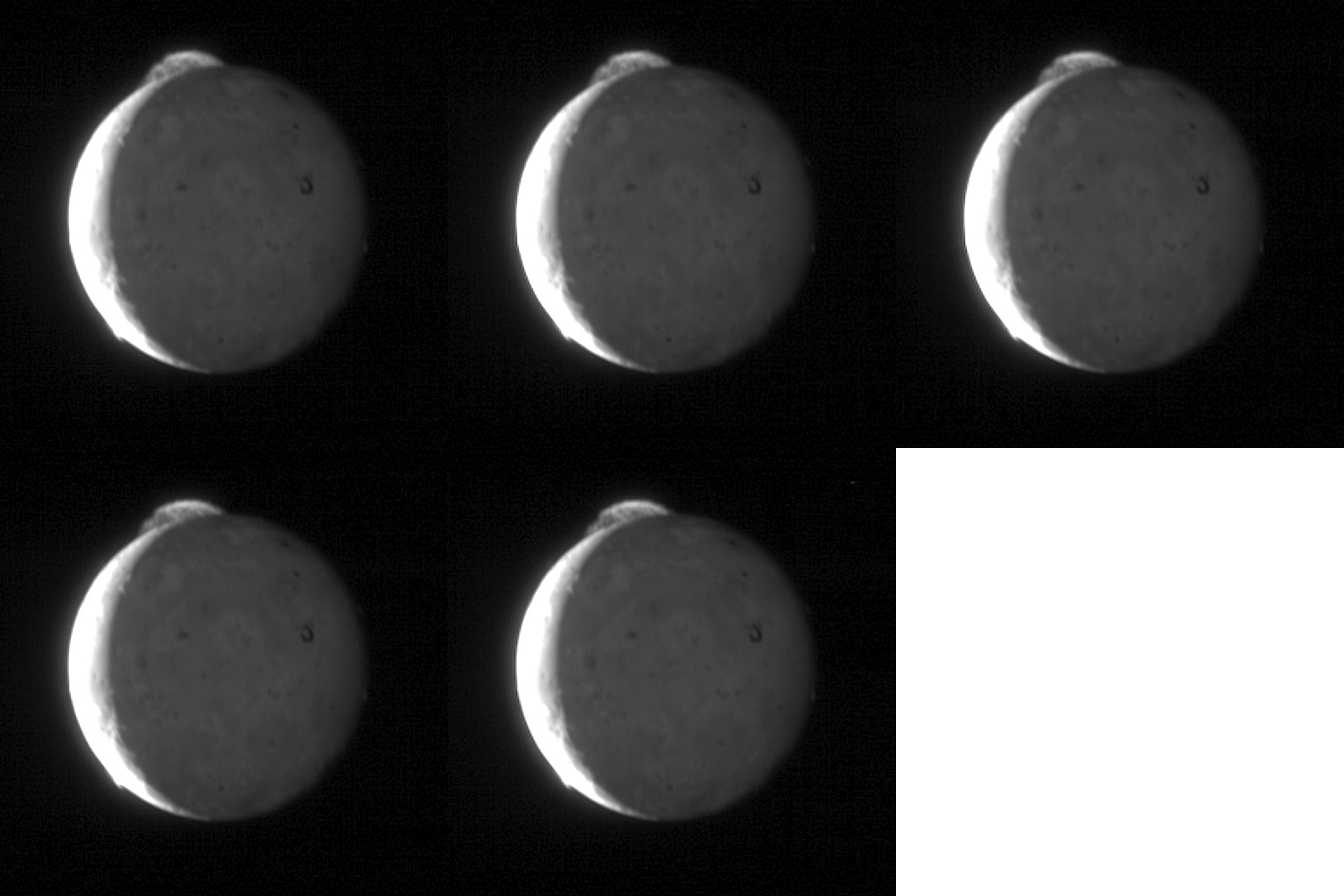
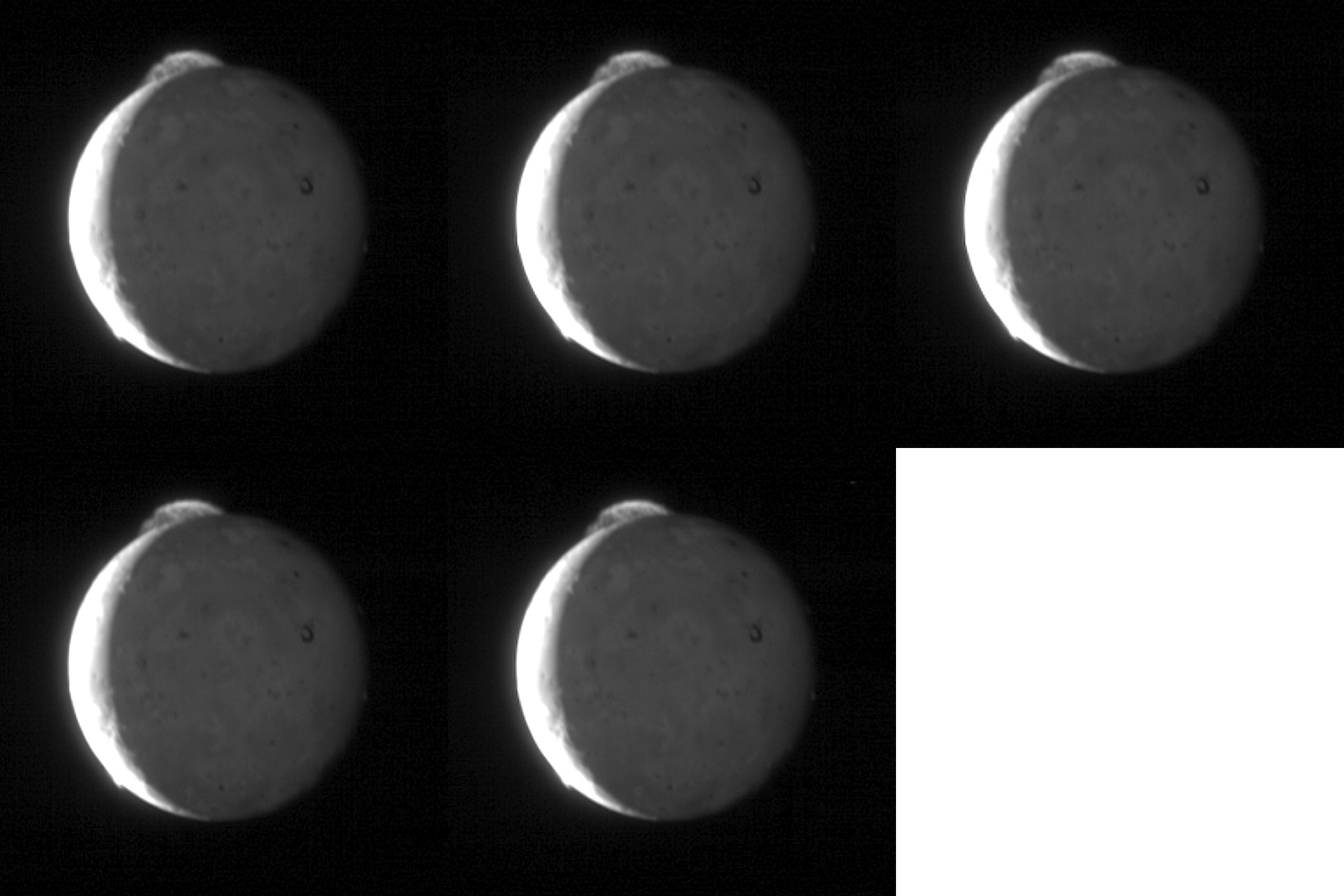
Eruption of the Tvashtar volcano on Io, as viewed from the New Horizons spacecraft during its Jupiter flyby (March 2007)
🎙️ PhilipTerryGraham · 8729 points · Posted at 09:58:30 on June 6, 2016 · (Permalink)
🎙️ PhilipTerryGraham · 8729 points · Posted at 09:58:30 on June 6, 2016 · (Permalink)
weaselinMTL · 443 points · Posted at 10:35:53 on June 6, 2016 · (Permalink)*
This is surreal. How big is that cloud? Do those eruption happen often?
minnesotan_youbetcha · 341 points · Posted at 11:10:13 on June 6, 2016 · (Permalink)
https://en.wikipedia.org/wiki/Tvashtar_Paterae
Damn, I'm trying to imagine a mile-high curtain of lava.
PocketPacifist · 74 points · Posted at 16:54:46 on June 6, 2016 · (Permalink)
This is gonna sound really stupid, and is probably easily explained by science, but how come stuff like this doesn't happen on Earth? I used to wonder the same about why Olympus Mons was bigger than Everest, even though Mars is a smaller planet.
elcarath · 296 points · Posted at 16:57:52 on June 6, 2016 · (Permalink)
Basically Olympus Mons is bigger than Everest because Mars is a smaller planet. Since Mars has lower gravity, you can build "structures" (here, mountains) much higher before they'll experience the same level of stress they'd experience on Earth and start to collapse out.
The way I saw it explained on /r/space before was that as bodies get smaller and smaller, the possible "mountains" get bigger and bigger until you finally get stuff that's so small they're nothing but funnily-shaped mountains - ie. asteroids.
PocketPacifist · 70 points · Posted at 17:21:33 on June 6, 2016 · (Permalink)
Wow, never looked at it from that angle. Always thought Mount Everest was probably just eroded more by moisture in the air or something dumb. Your explanation totally reversed my outlook on this sort of thing, and I thank you for it!
zazu2006 · 72 points · Posted at 17:39:33 on June 6, 2016 · (Permalink)
IIRC Everest is still growing a few inches a year.
Upon further Google fu about half an inch.
[deleted] · -2 points · Posted at 18:29:38 on June 6, 2016 · (Permalink)
[removed]
[deleted] · 26 points · Posted at 18:57:14 on June 6, 2016 · (Permalink)
[deleted]
RestInPeaceTexasRed · 29 points · Posted at 19:56:34 on June 6, 2016 · (Permalink)
I hate to be that guy but earths mantle is a plastic solid, not magma. There is no such thing as an ocean of magma, it's a huge misconception.
Source:I'm a geology grad student in igneous petrology
Haschlol · 11 points · Posted at 20:31:16 on June 6, 2016 · (Permalink)
Coming with facts is nothing to be ashamed of.
BalsaqRogue · 6 points · Posted at 20:37:14 on June 6, 2016 · (Permalink)
I did not know geology got as specific as "igneous petrology". That's pretty cool though.
LeoBattlerOfSins_X84 · 3 points · Posted at 20:51:39 on June 6, 2016 · (Permalink)
Going to ask the stupid questions. But why is it molasses-y liquid when it erupts? How does it convect? How is a plastic solid different from jello or wax?
heywaitaminutewhat · 5 points · Posted at 22:50:21 on June 6, 2016 · (Permalink)
The mantle is under extreme amounts a of pressure. Most materials at such high temperatures are only solid because of the pressure holding them that way. As they well up through the crust and erupt, that pressure is gone and the mantle material "melts" to become magma.
Source: math student doing geophysics modeling.
Tehwehah · 4 points · Posted at 21:03:57 on June 6, 2016 · (Permalink)
When the magma gets to the surface, pressure drops and it liquefies!
sageblitz · 3 points · Posted at 02:07:50 on June 7, 2016 · (Permalink)
Thanks for sharing. I would have continued to think otherwise if you didn't correct that misconception. Reddit is such a rich source of knowledge.
[deleted] · 2 points · Posted at 21:32:40 on June 6, 2016 · (Permalink)*
[deleted]
rhorama · 3 points · Posted at 23:04:32 on June 6, 2016 · (Permalink)
Inner core is solid, outer core is molten.
ManHole4Curiosity · -1 points · Posted at 19:05:17 on June 6, 2016 · (Permalink)
I'd have you know... Mars's mantle just had a thermo-inductive injection the likes of which only one humanoid has known.
OrdyHartet · 3 points · Posted at 19:43:18 on June 6, 2016 · (Permalink)
Care to elaborate?
BalsaqRogue · 2 points · Posted at 20:38:21 on June 6, 2016 · (Permalink)
I'm pretty sure he's talking about OP's mom.
Bobshayd · 1 points · Posted at 20:41:26 on June 6, 2016 · (Permalink)
Could also be talking about Matt Damon.
[deleted] · 2 points · Posted at 21:26:41 on June 6, 2016 · (Permalink)
Mars is home to the largest known volcano in the solar system, Olympus Mons. It's dead now, but is absolutely enormous, almost the size of France as you can see and depending on where you measure from, rises nearly 16 miles tall.
ManHole4Curiosity · 2 points · Posted at 21:50:12 on June 6, 2016 · (Permalink)
I bet Olympus Mon is about to gush it's moon goo all the face of Mars and Curiosity. Come back Curiosity. Come back.
PocketPacifist · 1 points · Posted at 21:47:26 on June 6, 2016 · (Permalink)
Dude, you're really sexual about Mars, aren't you? I'm not here to judge.
Haschlol · 9 points · Posted at 20:30:43 on June 6, 2016 · (Permalink)
Mountains on Earth do erode but that is the reason why mountains don't last forever here, the high gravity on Earth is the reason mountains do not grow to be gigantic.
notseriousIswear · 1 points · Posted at 23:09:22 on June 6, 2016 · (Permalink)*
Here's a representation of Earth without any water. 6 or 7 miles elevation change isn't a lot when the planet is so fuckin huge!
Edit: sourced from here.
Dawkinist · 11 points · Posted at 21:10:25 on June 6, 2016 · (Permalink)
I always thought it was because of Mars' lack of tectonic plates. On Earth, you get chains of volcanoes like in the Pacific ocean because the plates move around above the hotspots, but on Mars, the plume was left to accumulate in one spot until the magma in Mars cooled and solidified.
AizenEerz · 2 points · Posted at 13:52:03 on June 7, 2016 · (Permalink)
Yeah I'm pretty sure this is the correct reason for Olympus Mons being so big.
ursamaul · 7 points · Posted at 18:42:51 on June 6, 2016 · (Permalink)
so by that rule, the larger a celestial body is, the more "smooth" it becomes?
[deleted] · 30 points · Posted at 19:08:16 on June 6, 2016 · (Permalink)
Denser.
Neutron stars can be 7 miles in diameter, but a mountain on a neutron star is around 0.1mm high. They're smooooooth.
voodooacid · 7 points · Posted at 20:02:11 on June 6, 2016 · (Permalink)
Isn't it hot tho?
tricheboars · 16 points · Posted at 21:02:28 on June 6, 2016 · (Permalink)
Oh yeah. lots of friction on those. I bet it's hotter than a ma'fucker up 'dere.
[deleted] · 27 points · Posted at 21:53:28 on June 6, 2016 · (Permalink)
[deleted]
scumbagcoyote · 3 points · Posted at 23:49:39 on June 6, 2016 · (Permalink)
Good idea, just got to plan the arrival time just right.
[deleted] · 2 points · Posted at 00:55:44 on June 7, 2016 · (Permalink)
You can just warp in at light speed.
Poseidon-GMK · 2 points · Posted at 02:01:06 on June 7, 2016 · (Permalink)
Just make sure you land at the right time. They spin ~1000 times a second and are close to a million degrees kelven. But no problem! As long as the radiation or MASSIVE gravity doesn't kill you, you should vaporize rather quickly :)
scumbagcoyote · 1 points · Posted at 02:12:48 on June 7, 2016 · (Permalink)
Got it. Make it a quick stop.
Timmehhh3 · 1 points · Posted at 01:14:55 on June 7, 2016 · (Permalink)
They are not as hot as most young stars I'd assume, since they no longer undergo fusion.
voodooacid · 1 points · Posted at 17:05:28 on June 8, 2016 · (Permalink)
I meant hot as in, "I think it's hot in here". I dont think you would say that while you're on a young star.
Timmehhh3 · 2 points · Posted at 18:43:11 on June 8, 2016 · (Permalink)
Ah. I thought you were implying Neutron Stars were hot objects by astronomy standards. ^^>
Timmehhh3 · 1 points · Posted at 18:42:26 on June 8, 2016 · (Permalink)
Ah. I thought you were implying Neutron Stars were hot objects by astronomy standards. ^^>
texinxin · 4 points · Posted at 02:55:53 on June 7, 2016 · (Permalink)
If the Earth was scaled down to the size of a billiard cue ball, I would in fact be more smooth than a typical cue ball. Your "smooth" rule was dead on.
ArmouredDuck · 5 points · Posted at 21:25:10 on June 6, 2016 · (Permalink)
Building on this, Mars doesnt have tectonic plates like Earth, so when a pathway for lava opens up it usually stays in the same place for millions/billions of years, slowly building it up. Here on Earth as the plates shift they can make these volcanoes inert.
jcy · 8 points · Posted at 17:42:02 on June 6, 2016 · (Permalink)
it's not b/c earth has plate tectonics and the shifting of the plates prevents lava from building up and getting too tall?
elcarath · 9 points · Posted at 18:01:06 on June 6, 2016 · (Permalink)
I'm not a geologist, so take my words with a grain of salt, but I get the impression that the biggest mountains, like Everest, are actually formed by plate tectonics. Everest isn't volcanic, it's the result of the Indian subcontinent shoving northwards into the Asian plates, so plate tectonics preventing lava buildup isn't really relevant there.
As far as Olympus Mons is concerned, I seem to recall that it was formed by a lava hotspot, which is probably what you're thinking of, but if Mars' gravity were higher, I don't think Olympus Mons would have been quite so tall - it would have just slumped off to the sides more. But again, not a geologist.
croxis · 10 points · Posted at 18:33:31 on June 6, 2016 · (Permalink)
Plate tectonics on Earth keeps plates moving over hot spots. You can follow the movement of the Pacific plate by looking at the Hawaiian islands chain and sea mounts. Mars has no tectonics, less erosive factors, and less gravity so it allows the lava to keep building and building and building...
StrongStyleSavior · 6 points · Posted at 18:57:26 on June 6, 2016 · (Permalink)
this is the right answer i just watched a doc on plate tectonics. they specifically talk about mons being created due to lack of tectonic plates.
Xaeryne · 2 points · Posted at 19:49:38 on June 6, 2016 · (Permalink)
Yep. On Earth that corner of the plate would just be depressed under gravity, since the plates are basically floating on the mantle. The only exceptions are places like the Himalayas where two plates are colliding together.
brolix · 2 points · Posted at 02:32:33 on June 7, 2016 · (Permalink)
This is exactly why when you get even further out like the moons of Saturn, you can get mountains made of ice.
How cool/scary looking is that?
Balind · 1 points · Posted at 18:06:00 on June 6, 2016 · (Permalink)
Not to mention it is thought that Mars didn't and doesn't have plate tectonics, so a hot spot in one location is there for literally billions of years.
Golokopitenko · 1 points · Posted at 18:43:49 on June 6, 2016 · (Permalink)
Can you say it's higher though? From the base to the top maybe. But not from the center of the planet to the peak it is not.
elcarath · 8 points · Posted at 19:25:16 on June 6, 2016 · (Permalink)
No, but mountains are typically measured from base to summit. If we're measuring from the centre of the earth, Everest isn't the tallest mountain any more either.
Xaeryne · 8 points · Posted at 19:50:11 on June 6, 2016 · (Permalink)
Everest isn't the tallest mountain base-to-summit either. It is the highest point above sea level, though.
jccwrt · 17 points · Posted at 19:49:18 on June 6, 2016 · (Permalink)
Big fountain eruptions like that do happen on Earth, but they're infrequent. Mt. Etna in Sicily usually produces a 500-600 m lava fountain every decade, and an eruption in 1999 produced a fountain that was over 2 km high. Vesuvius probably produced a fountain that was 3 km high when it erupted in 1779.
There are a few reasons that Io has such enormous eruptions. In no particular order:
1) Io has a lot more energy warming it. Since it's constantly kneaded by tidal forces, its mantle is a lot warmer. This heats the magma to over 1600C, producing a type of lava called komatiite. We find komatiite on Earth, but it's mostly from rocks older than about 2.5 billion years. The lava flows we find show that the lava was so superheated that it acted more like a heavy gas than a liquid. This means that eruptions on Io can blast material higher just because there's not as much internal force holding the magma together.
The amount of energy also means that large eruptions are a lot more frequent. Voyager 1 detected 9 plumes, 7 were still active when Voyager 2 flew by 4 months later, Galileo saw some active areas despite having few global images of Io, and New Horizons spotted some as seen in OP's post.
2) Lava chemistry. Io's lava is rich in sulfur, which reduces the viscosity of the magma. So with the sulfur present, an already super-fluid lava becomes even more so.
3) Lower gravity. Io is only about the size of the Moon, so its surface gravity is only about 1/6th of the Earth's. An eruption of the same energy can launch much higher simply because it's not getting as much downward acceleration trying to pull it back down to the surface.
4) No air resistance. It's a very small factor, but an eruption on Io isn't having to push air out of the way. Ash ejected out of a volcano follows a purely ballistic trajectory, instead of hitting the stratosphere or the jet stream and being redirected outwards instead of upwards.
There's probably some other factors at play, but those should be the major ones.
PocketPacifist · 7 points · Posted at 20:00:32 on June 6, 2016 · (Permalink)
Wow, it's amazing what scientists can tell about a moon like Io, despite it being so far away and humans never visiting it. And you sure know your stuff, kudos! Blows my mind all the knowledge we have about things such as the lava flows on distant worlds. Usually I just come to /r/space to see some cool pictures, but it amazes me what I can learn here too.
jccwrt · 7 points · Posted at 20:15:45 on June 6, 2016 · (Permalink)
Situations like this are where the lesser-known spacecraft instruments show their worth. You can get an idea of the lava's temperature and composition just by looking at the color of the magma. You can get the temperature by looking at the black-body radiation profile, while certain elements or molecules absorb extremely specific colors of light. Cameras producing the pretty pictures for public release usually don't have enough color resolution to do this kind of work, so you have to turn to things like spectrometers. They rarely make the same spectacular images, but they're usually the geochemical workhorse in any mission.
And armed with the insights that modeling the environment these volcanoes formed in, you can figure out a lot about what's going on to produce these eruptions.
connormxy · 16 points · Posted at 17:00:05 on June 6, 2016 · (Permalink)
So let's imagine that on Earth and on Io, lava shoots from volcanoes at the same speed. With gravity so much lower than on Earth, lava will shoot way higher in the sky and take much longer to fall.
PocketPacifist · 10 points · Posted at 17:17:06 on June 6, 2016 · (Permalink)
I never even considered gravity, haha! I guess that makes perfect sense after all. Time to educate myself, thanks dude!
jenbanim · 4 points · Posted at 19:38:27 on June 6, 2016 · (Permalink)
Other people are correct about gravity, but a large additional factor is Io HOT AS SHIT. It's being constantly massaged (but in a very volcanic, non relaxing way) by the nearby orbits of the Galilean moons. The tidal forces result in lots of internal heating, which ends up leaving the surface of the planet on fucking enormous volcanoes.
ksohbvhbreorvo · 2 points · Posted at 18:24:56 on June 6, 2016 · (Permalink)
1.) lower gravity
2.) no plate tectonics so it stays above the same hotspot forever. Think Hawaii but all the islands and underwater mountains added together
antshekhter · 1 points · Posted at 19:30:46 on June 6, 2016 · (Permalink)
Io is very small, thus weaker gravity. This allows high pressure events like this to be magnified in scale relative to earth.
sammie287 · 1 points · Posted at 22:23:14 on June 6, 2016 · (Permalink)
Io is very geologically active because of tidal stress on the planet from Jupiter. The entire moon is under a great deal of stress from stretching and contracting, causing very frequent eruptions on the surface. The earth doesn't have anything putting it under stress like this.
[deleted] · 1 points · Posted at 18:02:23 on June 6, 2016 · (Permalink)
Gravity. When the ground makes a molten shit on Earth, it gets pulled back down pretty quick, and the geologic structures are also subject to that same gravity.
In the case of Mars, you're looking at a bit less than half the gravity of Earth- 3.71 m/s2 for Mars relative to Earth's 9.8- so it's a very real difference.
For reference, Io's is a lean 1.76 m/s2. So it really does just go everywhere.
PocketPacifist · 2 points · Posted at 18:19:25 on June 6, 2016 · (Permalink)
The power of science is staggering. Seriously, gravity is awesome. I kinda wish stuff like this happened on Earth (obviously without the massive death tolls it'd probably result in) just so we could see it.
ManHole4Curiosity · 1 points · Posted at 18:40:05 on June 6, 2016 · (Permalink)
No. What's amazing is Curiosity. It's power drill is staggering. Come home, I'm so curious.
[deleted] · 7 points · Posted at 17:14:28 on June 6, 2016 · (Permalink)
Now imagine it raining lava everywhere up to 450 miles from the eruption.
aros2600 · 25 points · Posted at 17:40:13 on June 6, 2016 · (Permalink)
My kids would survive... they've spent their lifetime training to avoid hot lava
ibetsantaheardthat · 10 points · Posted at 18:02:38 on June 6, 2016 · (Permalink)
I've played 'the floor is lava' but never 'the sky and the floor are lava'. You've really bumped up the difficult level for your kids, I imaging they'll be prepared for anything life throws at them.
MrNickNifty · 5 points · Posted at 21:00:03 on June 6, 2016 · (Permalink)
This week on doomsday preppers: the only kids fully prepared for the Yellowstone super volcano.
excellent_name · 2 points · Posted at 21:54:12 on June 6, 2016 · (Permalink)
None of us are prepared for that
[deleted] · 4 points · Posted at 17:41:09 on June 6, 2016 · (Permalink)
Are you trying to find an excuse to send them to Io?
Radda210 · 3 points · Posted at 23:14:37 on June 6, 2016 · (Permalink)
Aren't all parents, secretly?
zigziggy7 · 2 points · Posted at 17:22:14 on June 6, 2016 · (Permalink)
How hot is that lava?
Balind · 2 points · Posted at 18:07:40 on June 6, 2016 · (Permalink)
Warm enough that you wouldn't want to be caught in it.
zigziggy7 · 1 points · Posted at 21:18:24 on June 6, 2016 · (Permalink)
Ok, but I was wondering cause if its going up 400 km, then the gas has got time to cool when it gets closer to the top, so the lava is hot but the gas escaping will start to cool when it hits the vacuum of space.
Balind · 1 points · Posted at 21:46:53 on June 6, 2016 · (Permalink)
I doubt it'll cool. I don't think Io has much of an atmosphere (especially that high up) so all heat loss will be by radiating off of the lava, which is pretty slow.
zigziggy7 · 1 points · Posted at 22:54:12 on June 6, 2016 · (Permalink)
Hmm, yeah you're right, vacuums insulate not disperse heat, so yeah that would be interesting how hot it is up there! Like that looks like if a satellite was up there it would be in range and get fried. Definitely would be interesting...
majesticjell0 · 1 points · Posted at 17:36:55 on June 6, 2016 · (Permalink)
If it's that big how does it not just spew into space? Is the gravity just strong enough, or are the particulates and whatnot heavy enough to stay down?
[deleted] · 3 points · Posted at 17:42:54 on June 6, 2016 · (Permalink)
Well technically, without an atmosphere, it is shooting into space. Eventually gravity brings back the big pieces.
zombiereign · 1 points · Posted at 19:00:51 on June 6, 2016 · (Permalink)
So the smaller pieces, in essence, become new asteroids?
Chiefhammerprime · 1 points · Posted at 20:19:33 on June 6, 2016 · (Permalink)
If that curtain is a mile high, then Io must be pretty small. Look at the height of that curtain in relation to the size of the moon.
duskykmh · 1 points · Posted at 23:09:17 on June 6, 2016 · (Permalink)
Well, the Burj Khalifa is a bit over half a mile... so twice the size of this:
https://upload.wikimedia.org/wikipedia/en/9/93/Burj_Khalifa.jpg
Druggedhippo · 35 points · Posted at 14:39:27 on June 6, 2016 · (Permalink)*
Volcanic plumes(not necessarily Tvashtar) were imagedsource by Voyager 1 in 1979 and by Galileosource in 1997 as well, so I think it's pretty fair to say they happen "often"TM
Max_TwoSteppen · 9 points · Posted at 15:37:51 on June 6, 2016 · (Permalink)
How is there so much volcanic activity? Is Io very young? I'd think a small body like that would have cooled already if it was anywhere close to as old as Earth.
seravoleus · 36 points · Posted at 15:42:28 on June 6, 2016 · (Permalink)
It is being "stretched" between Jupiter and the other big moons, keeping it really hot. I thinks it's called Tidal Heating.
Yenraven · 31 points · Posted at 15:50:31 on June 6, 2016 · (Permalink)
It's very close to Jupiter. Only 421,000 km and making a full orbit in under two days. The tidal forces of jupiter cause 100 meter changes in its surface. Compare that to our overly sized moon causing only 30cm of changes in earth. All that friction generates a lot of heat.
m636 · 19 points · Posted at 15:57:18 on June 6, 2016 · (Permalink)
A FULL orbit of Jupiter in two days?? Holy shit I had no idea.
Sikletrynet · 6 points · Posted at 16:14:12 on June 6, 2016 · (Permalink)*
Yep. The closer the orbit, the higher the velocity and thus lower the period of the orbit. Since Io's orbit is so close, it means the orbital period is damn low.
MyWorkAccountThisIs · 2 points · Posted at 19:58:16 on June 6, 2016 · (Permalink)
Oh. Two days instead of week.
ValidatedQuail · 1 points · Posted at 00:44:43 on June 7, 2016 · (Permalink)
I thought it was the higher it is, the greater the velocity? Using logic from rocket science, you need more velocity to achieve a higher orbit. The orbit just appears slower due to the greater distance it must cover.
Sikletrynet · 1 points · Posted at 01:05:55 on June 7, 2016 · (Permalink)
No, the actual velocity at a certain point is lower, the higher the altitude of the orbit. You need more energy to get there in the first place, that is correct though.
V=Square Root GM/r
Where V is velocity, G is the graviational force, M is the parent body's mass, and r is the radius of the orbit. As you're dividing by the radius, you can easily see the higher the radius of the orbit, the lower the velocity is going to be.
jccwrt · 6 points · Posted at 20:02:35 on June 6, 2016 · (Permalink)
Proximity to Jupiter isn't the main cause of the high tides. If it were by itself, Io would be tidally locked to Jupiter and there wouldn't be any tides. What raises the tides is the orbital resonance with Europa and Ganymede. The gravitational pull of those moons is strong enough to raise a tide, and the axis of the tidal pull changes based on the moons' relative positions. It's usually misaligned with a line drawn perpendicular from Io's orbit to Jupiter's center, and the torque that produces generates the tidal bulge and immense amount of heat energy.
dm_fucking_t · 1 points · Posted at 22:58:52 on June 6, 2016 · (Permalink)
Interesting. Could a volcano of this magnitude itself alter the orbit? Like letting air out of a balloon? (Or a space suit like in the mars movie)
jccwrt · 3 points · Posted at 23:15:26 on June 6, 2016 · (Permalink)
No. Most of this material doesn't escape from Io (so there's no net transfer of momentum from Io to its orbit), and the stuff that does escape is such a small fraction of Io's mass that it's negligible. During powerful eruptions it might be losing 1000 kg/s to space, which sounds like a lot, but Io's mass is 89,319,380,000,000,000,000 kg. Most of that mass is lost in a diffuse cloud (so again there's no net momentum transfer in one direction or another), and some of that eventually lands back on Io again after spending time in orbit around Jupiter.
dm_fucking_t · 1 points · Posted at 04:10:53 on June 7, 2016 · (Permalink)
Thank you for that explanation!
Max_TwoSteppen · 3 points · Posted at 16:27:31 on June 6, 2016 · (Permalink)
Holy shit, 100m changes 0.0 Think of the overpressure.
wggn · 1 points · Posted at 16:59:57 on June 6, 2016 · (Permalink)
so like the 100m wave in interstellar?
Yenraven · 9 points · Posted at 17:07:48 on June 6, 2016 · (Permalink)
Not a wave, a tide of rock and lava. The material isn't as fluid as water so it's more of a deformation of the moon itself. Like this http://spaceplace.nasa.gov/io-tides/en/io_diagram.en.gif
http://spaceplace.nasa.gov/io-tides/en/
OSUfan88 · 5 points · Posted at 16:35:53 on June 6, 2016 · (Permalink)
It's really a shame that Galileo's main antenna didn't work properly. So much valuable information was lost. What we did get was highly compressed.
jccwrt · 3 points · Posted at 21:07:32 on June 6, 2016 · (Permalink)
Voyager 1 also got a good view of Pele volcano erupting about a day before its closest approach to the moon. Unfortunately processing methods of the time were very slow, and most images were printed on film or paper. They didn't really display the full dynamic range of the images, so this plume wasn't noticed for a few days after the flyby, when the navigation team spotted the same plume as Voyager 1 looked back at Io. It's a good example of how discoveries can hide in plain sight if you're not specifically looking for them.
That's part of the reason I'm interested in reprocessing old spacecraft data. A lot of images (like the one above) were produced on the quick as part of the "Instant Science" program, and eventually became the definitive mission imagery when NASA never went back and did more quality work because of a lack of funding and having to move on to other missions. The images look a lot nicer when they're reworked with more modern computers. Here's a version of the same image above that I finished a couple weeks ago. (It's a Flickr link, I generally prefer it over Imgur for this kind of thing since their image compression has a tendency to destroy detail near the edge of visibility.)
🎙️ PhilipTerryGraham · 3 points · Posted at 22:30:51 on June 6, 2016 · (Permalink)
Holy shit, dude! I just looked at your Flickr page, and I absolutely love the stuff that you've done! Your reprocessed Voyager images are some of the best I've ever seen! Thanks not only for the hard work that you've done, but for also releasing them under a Creative Commons Attribution license! It really annoys me when peeps take NASA images, reprocess them and then copyright/claim them as their own, so many, many thanks for that, as well!
I do have a question - are you looking at/planning to reprocess any of the JunoCam data that'll come in once Juno starts it's mission next month? NASA and SwRI have been really pushing amateur image processors to get involved; peeps will be voting on what images JunoCam will take, and once they're taken, the raw images will be put up for amateur processors to play with.
jccwrt · 2 points · Posted at 22:44:34 on June 6, 2016 · (Permalink)
Yeah, that annoys me as well. I think in this case strict copyright licensing is actually hindering the exploration of older data sets - with licensing fees very few reprocessed images become widespread, and so everyone just sees the versions heavily affected by generation loss and assumes those data sets are just poor quality. Which is bad, because with a little bit of polish, the Mariner, Viking and Voyager data sets are absolutely gorgeous. (And still scientifically useful, too!)
As for Juno, I'm looking forward to the opportunity to work with JunoCam pictures, but I'm starting a Ph.D in planetary science (my first day is the day after Juno orbit insertion, actually) so I may be neck deep in research by the time Juno gets down to taking pictures in earnest. I'm trying to wrap up as many of my Voyager reprocessing projects as possible before I start, because I may end up having to shelve them for a few years depending on how busy I get.
temporarilyyours · 3 points · Posted at 16:01:19 on June 6, 2016 · (Permalink)
New Horizons: March 1, 2007 (2/2)
o0DrWurm0o · 10 points · Posted at 15:59:07 on June 6, 2016 · (Permalink)
Io is the most geologically active body in the solar system. It has constant volcanic activity.
OSUfan88 · 3 points · Posted at 16:39:13 on June 6, 2016 · (Permalink)
I'm surprised that Mercury isn't more exciting with it being so close to the sun. It has to take the crown for "most boring planet".
o0DrWurm0o · 14 points · Posted at 16:41:32 on June 6, 2016 · (Permalink)
We should petition to change the name to "Small, hot, dumb rock."
n0umena · 1 points · Posted at 01:25:49 on June 7, 2016 · (Permalink)
Xavier: Renegade Angel? “You know, the big dumb hot ball... in the sky!”
OSUfan88 · 1 points · Posted at 16:49:24 on June 6, 2016 · (Permalink)
That's the best idea I've heard all day!
BAXterBEDford · 3 points · Posted at 16:56:51 on June 6, 2016 · (Permalink)
With Io though (iIrc), it's because of it being caught between Jupiter and its other moons. The gravitational pulls heat it by deforming it like you were squeezing an orange in your hand.
PostPostModernism · 14 points · Posted at 17:12:18 on June 6, 2016 · (Permalink)
I hate when oranges turn into magma when I squeeze them.
jenbanim · 2 points · Posted at 19:40:23 on June 6, 2016 · (Permalink)
It's orbit is pretty neat-o though. It's got some weird 2:3 resonance with the sun, and its precession helped prove general relativity.
OSUfan88 · 1 points · Posted at 20:38:06 on June 6, 2016 · (Permalink)
Mercury is the Pug of the planets.
LeoBattlerOfSins_X84 · 2 points · Posted at 21:00:40 on June 6, 2016 · (Permalink)
Mercury actually has some cool things going for it.
1: Is mostly heavy metal.
2: One side is super hot, other is super cold.
3: It has a magnetic field
4: Once had volcanoes.
5: Wicked craters.
JeremyHillaryBoob · 3 points · Posted at 04:20:31 on June 7, 2016 · (Permalink)
You forgot: almost perfect 0 degree axial tilt! Well, I think that's cool...
OSUfan88 · 1 points · Posted at 23:35:22 on June 6, 2016 · (Permalink)
I had no idea it had a magnetic field. I though it was dead inside, without a spinning core?
I think it's a cool thought that some of the craters on the poles have temperatures that would be OK for us, with temperatures hundreds of degrees too hot, and hundreds of degrees too cold just nearby.
LeoBattlerOfSins_X84 · 1 points · Posted at 00:49:33 on June 7, 2016 · (Permalink)
Mercury's magnetic field is global. So it's not dead. It has a huge iron core, and it's outer iron core is still sloshing like the Earth's. I assume it's from the tidal forces of the sun. It's magnetic field does deflect solar radiation.
If I were to chose a place to colonize, I'd say Mercury is a good bet.
OSUfan88 · 1 points · Posted at 01:43:41 on June 7, 2016 · (Permalink)
wow, interesting. I know the delta V to get to Mercury makes it one of, if not THE most difficult planet to get to. I would be neat if humans make it there in the next 100 years or so.
Balind · 1 points · Posted at 18:09:46 on June 6, 2016 · (Permalink)
I'd like us to send a lander there eventually though. Seems like it'd be cool.
OSUfan88 · 2 points · Posted at 18:15:31 on June 6, 2016 · (Permalink)
Lander: "Of all of the planets, why did they have to send me to this boring one?".
Jokes aside, I do think that would be neat. It would have to be a very, very light lander, and the delta V to get to mercury is very high. I believe it is the hardest planet to get to and land on.
Balind · 1 points · Posted at 19:26:46 on June 6, 2016 · (Permalink)
Really? That's surprising to me. I figured it'd be relatively easy. Why is the Delta V so high? I'm guessing it's less than the outer planets?
OSUfan88 · 2 points · Posted at 20:06:03 on June 6, 2016 · (Permalink)
It's sort of hard to explain, but it's a result of orbital mechanics. Here's my shot...
So as you get further away from the sun, the gravity becomes less and less, so accelerating will 1 km/second will change your orbit at 10 AU's away from the sun than it will at 1 AU (distance from Earth to the Sun). Once you get out by Jupiter, even a small amount of speed increase slings you very, very far out.
To get to Mercury, you have fire in the opposite direction as the Earth goes to "fall" closer to the Sun. As you get closer, gravity get's stronger and stronger, so it takes more and more delta V (change in velocity) to lower the orbit.
Here is a delta V chart to go from Earth's surface, to any other place.
Earth to Mercury orbit : 21.26 km/s delta V (9.4 + 3.21 + 8.65)
Earth to Neptune orbit : 18.00 km/s delta v (9.4 + 3.1 + 5.39)
https://imgur.com/AAGJvD1
Balind · 2 points · Posted at 20:26:58 on June 6, 2016 · (Permalink)
Huh. I figured you could sorta just fall towards Mercury as it's closer to the sun's gravity well, but this makes sense. I had no idea it took so much energy. No wonder we don't send many probes to Mercury even though it's ostensibly closer physically.
OSUfan88 · 1 points · Posted at 20:42:58 on June 6, 2016 · (Permalink)
Yep.
Look at it this way... We are always "falling" towards the sun. We are just moving so quickly forward, that we miss it. If we slow down our forward velocity, we end up falling closer to the Sun. The problem is, as we fall closer to the Sun, we pick up more speed, which then needs to be canceled out on the other side.
So to lower an orbit, two burns have to occur at opposite sides.
I highly, HIGHLY, #HIGHLY recommend Kerbal Space Program. Not only is it addictive, and a lot of fun, but it will teach you all about orbital mechanics.
Balind · 1 points · Posted at 21:44:25 on June 6, 2016 · (Permalink)
Yeah, I bought KSP a few months back because it looked cool and it seemed like a good way to learn about orbital mechanics.
I definitely intend to get into it pretty heavily eventually, though the initial learning curve seems steep.
OSUfan88 · 1 points · Posted at 23:37:34 on June 6, 2016 · (Permalink)
Awesome! check out Scott Manley:
https://www.youtube.com/user/szyzyg
He has some GREAT videos, from KSP 101, to advanced classes. They're a lot of fun to watch.
Also, if you haven't already, check out /r/KerbalSpaceProgram . It full of fun stuff!
vikingerik · 1 points · Posted at 19:25:06 on June 7, 2016 · (Permalink)
Here's a simpler way of looking at the math. Kinetic energy is proportional to velocity squared. Mercury's orbital velocity is 47 km/sec. Earth's is 30. An object at infinity (beyond the solar system) would be 0. Square those numbers and you see that the Mercury-Earth energy delta is greater than that of Earth-infinity.
What's hard isn't just reaching Mercury, it's matching its solar orbital velocity so you can orbit or land on it. If you fall towards Mercury but don't bleed off the speed acquired by falling, you end up going past Mercury back out to aphelion at Earth's orbital distance.
Balind · 1 points · Posted at 04:07:42 on June 8, 2016 · (Permalink)
That makes sense. There's no friction, so you're essentially gaining energy by going towards Mercury, and you'd have to lose that energy somehow - either by going back out to Earth orbital distance, or by using fuel reserves.
jontan7 · 4 points · Posted at 16:47:01 on June 6, 2016 · (Permalink)
Yes, the cloud is big. We get it, you vape
Druggedhippo · 73 points · Posted at 14:28:27 on June 6, 2016 · (Permalink)*
And (not animated) in color. source and anothersource.
luke_in_the_sky · 108 points · Posted at 17:19:40 on June 6, 2016 · (Permalink)
Thank you. I used it to colorize the gif
http://i.imgur.com/TAUkMfc.gifv
[deleted] · 3 points · Posted at 00:32:25 on June 7, 2016 · (Permalink)
you should add it to the wiki article, if legally possible
Niyeaux · 3 points · Posted at 01:58:37 on June 7, 2016 · (Permalink)
Pretty sure all NASA content is public domain.
Taiga_Blank · 27 points · Posted at 15:03:59 on June 6, 2016 · (Permalink)
Is there an explanation for why the lava appears blue, as opposed to the usual orange-red we get on Earth?
Druggedhippo · 40 points · Posted at 15:07:01 on June 6, 2016 · (Permalink)
The blue plume is dust not lava.
Taiga_Blank · 21 points · Posted at 15:08:55 on June 6, 2016 · (Permalink)
That sounds reeeeeeeeallllllly obvious now. Guess I just got caught up on the idea of blue lava. Thanks.
SovietSparkle · 20 points · Posted at 16:28:12 on June 6, 2016 · (Permalink)
You don't even have to leave Earth to find blue lava!
Serima · 8 points · Posted at 18:05:02 on June 6, 2016 · (Permalink)
Molten sulfur?? That must smell really bad!
Fred-Bruno · 2 points · Posted at 03:22:20 on June 7, 2016 · (Permalink)
Preeeeeetty sure that's just Phazon
pepedou · 66 points · Posted at 13:08:18 on June 6, 2016 · (Permalink)
Can you imagine the amount of energy released at that moment? Standing there would've been amazing!
[deleted] · 90 points · Posted at 13:50:20 on June 6, 2016 · (Permalink)*
[deleted]
dblmjr_loser · 36 points · Posted at 14:45:46 on June 6, 2016 · (Permalink)
Now this is an orbital tourism destination!
FryBurg · 6 points · Posted at 15:36:39 on June 6, 2016 · (Permalink)
I wrote a childrens book called, "Nuts the Hamster and his Journey to Pluto!"
Wish I would have known about this gem when he got to Jupiter.
Yes, the Uranus part is hilarious.
fakename5 · 2 points · Posted at 16:59:00 on June 6, 2016 · (Permalink)
time for a revised second edition to be released.
TacoRedneck · 8 points · Posted at 19:44:44 on June 6, 2016 · (Permalink)
Knowing college textbooks it will cost $200 more than the last edition and the only thing different is that the text and questions have been moved around to make the older version unusable for a class and there are minor spelling corrections.
[deleted] · 1 points · Posted at 17:42:51 on June 6, 2016 · (Permalink)
Do they have podracing there?
KentWeed · 3 points · Posted at 17:45:12 on June 6, 2016 · (Permalink)
why would you be vaporized?
[deleted] · 2 points · Posted at 18:15:06 on June 6, 2016 · (Permalink)
[deleted]
ch00f · 3 points · Posted at 20:50:33 on June 6, 2016 · (Permalink)
I'm not too certain about that. In the vacuum of space, heat is transmitted very inefficiently. With no medium through which to conduct or convect, a reflective suit would probably do a decent job of keeping you cool. This is of course assuming you aren't physically struck by any of the ejected particles.
Druggedhippo · 10 points · Posted at 14:48:22 on June 6, 2016 · (Permalink)*
Not Tvashtar, but another plume imaged by Voyager 1:
Edit:
Here is a calculation of speeds of the plume of Tvashtar from New Horizonssource showing 0.7km/second.
[deleted] · 1 points · Posted at 17:45:57 on June 6, 2016 · (Permalink)
Is the velocity affected by gravity in these measurements? Or does that not matter in this case (difference in gravitational pull between earth and io)
tigersharkwushen_ · 7 points · Posted at 16:28:06 on June 6, 2016 · (Permalink)
So is standing right next to a nuclear bomb going off.
Hershieboy · 2 points · Posted at 16:12:57 on June 6, 2016 · (Permalink)
I'm just imagining at one point humans harnessing that energy, 2254 is going to be an exciting time in history.
peteroh9 · 1 points · Posted at 16:20:20 on June 6, 2016 · (Permalink)
How did you choose 2254?
Hershieboy · 6 points · Posted at 16:44:30 on June 6, 2016 · (Permalink)
Randomly, while still considering at least 200 years to colonize the Moon and Mars, allowing for strategic launch locations, resupply points, and communication relays. While also hoping that the strongest nations ally themselves as a united fleet for space travel in order to exploit the larger gains of extra-planetary colonization.
pepedou · 4 points · Posted at 17:28:29 on June 6, 2016 · (Permalink)
That was surprisingly specific.
kokosgt · 2 points · Posted at 21:14:01 on June 6, 2016 · (Permalink)
http://fallout.wikia.com/wiki/Timeline#2254
Sounds fun
Rechamber · 39 points · Posted at 15:02:30 on June 6, 2016 · (Permalink)
My word... the sheer scale of this is almost beyond belief. How utterly and truly spectacular, and a true privilege to see.
bulbouscorm · 2 points · Posted at 00:20:10 on June 7, 2016 · (Permalink)
Oh dang I need to take a page from your book... all I can think of is how unfair it is to never see this with my own eyes, and also why can't we hurry some high-def cameras into space!
biscuitatus · 12 points · Posted at 16:08:36 on June 6, 2016 · (Permalink)
Do volcanic eruptions only take place on celestial bodies that have molten cores?
FranOntanaya · 10 points · Posted at 16:20:21 on June 6, 2016 · (Permalink)
Cryovolcanism can happen on bodies with subsurface liquid and otherwise solid cores.
Xaurum · 5 points · Posted at 16:55:00 on June 6, 2016 · (Permalink)
The fact is that Io would propably have a solid core if things were different.
In this case, the different gravitational attraction of Jupiter on differents parts of Io (because some are regions closer to the Jupiter than others) ends up "squeezing" the satellite and heating it up due to inner friction forces. This heat builds up, melting some parts of its core and creating those curious volcanoes you just saw.
biscuitatus · 2 points · Posted at 17:28:07 on June 6, 2016 · (Permalink)
That's so crazy! Gravity is a weird thing
MyWorkAccountThisIs · 1 points · Posted at 19:59:26 on June 6, 2016 · (Permalink)
Not sure but I'm sure you could find out by searching for eruptions on celestial bodies.
mafiaking1936 · 6 points · Posted at 17:35:30 on June 6, 2016 · (Permalink)
So would the thrust from that big an eruption affect the moon's orbit any?
NemWan · 3 points · Posted at 19:55:36 on June 6, 2016 · (Permalink)
Almost no mass is getting pushed out of the moon's gravity well so the moon is not getting pushed much either.
L-espritDeL-escalier · 1 points · Posted at 22:32:35 on June 6, 2016 · (Permalink)
Not on Io, but Enceladus experiences thrust from volcanism. I wrote a reply here to a similar question if you're interested.
TacoRedneck · 0 points · Posted at 19:46:06 on June 6, 2016 · (Permalink)
I need to know this as well. That thing should be rocketing out of the solar system right now.
L-espritDeL-escalier · 1 points · Posted at 22:35:08 on June 6, 2016 · (Permalink)
Io does not eject any mass into space. It all falls back down. Per Newton's 3rd law, the ejected mass pulls on Io just as much as Io pulls on it, negating any "recoil" experienced by ejecting it in the first place. So if nothing ever leaves Io, it experiences no thrust.
TacoRedneck · 1 points · Posted at 23:42:12 on June 6, 2016 · (Permalink)
You're right. I wasn't thinking of the right frame of reference.
CompiledIntelligence · 13 points · Posted at 15:37:17 on June 6, 2016 · (Permalink)
Nothing short of spectacular. What we are seeing is probably the plume of gas rising to ~385km from the surface. Also, Juno is closing in on Jupiter and its moon - can't wait for the pictures and videos that will come from that!
0thatguy · 6 points · Posted at 17:28:20 on June 6, 2016 · (Permalink)
The resolution on Io will not be very good. Here's a mockup I made of what Io will look like through JunoCam at the closest possible distance between Juno and Io that could ever happen. Not very good.
CompiledIntelligence · -1 points · Posted at 18:13:05 on June 6, 2016 · (Permalink)
Don't you mean the resolution of the cameras on Juno? I doubting whether physical objects has a given resolution :D
Elunetrain · 1 points · Posted at 19:56:36 on June 6, 2016 · (Permalink)
The pictures it's taking have low resolution
LaboratoryOne · 3 points · Posted at 18:54:02 on June 6, 2016 · (Permalink)
I've never been so awe struck by any other space-related media, and that is saying something! This is so much more striking to me than any nebula or black hole because it's much more fathomable, yet still remarkable.
[deleted] · 3 points · Posted at 21:07:53 on June 6, 2016 · (Permalink)
[deleted]
Bacch · 1 points · Posted at 01:30:15 on June 7, 2016 · (Permalink)
There's a joke in there about how tiny that image is...seriously though, do you have a link to higher res images of the same? I would love to see them!
[deleted] · 2 points · Posted at 16:14:16 on June 7, 2016 · (Permalink)
[deleted]
Bacch · 1 points · Posted at 02:14:49 on June 8, 2016 · (Permalink)
No worries, just thought I'd check. Was on my phone so not as easy to image search and find a quality one.
[deleted] · 4 points · Posted at 18:40:03 on June 6, 2016 · (Permalink)
[deleted]
A_Tall_Bloke · 3 points · Posted at 18:51:04 on June 6, 2016 · (Permalink)
But how do we know it wasn't a giant insect like creature burrowing deeper into the planet
elliotron · 2 points · Posted at 17:21:05 on June 6, 2016 · (Permalink)
Are volcanos on Io named after Hindu god or gods of fire and fire-related activities?
volcanopele · 4 points · Posted at 19:04:22 on June 6, 2016 · (Permalink)
They are named after dieties of volcanoes, fire, smithing, etc.
SuburbanStoner · 2 points · Posted at 18:04:23 on June 6, 2016 · (Permalink)
This may be a really dumb question, but is there any conceivable possibility of a planet or moon ever being thrusted like a rocket even slightly from some kind of super eruption?
L-espritDeL-escalier · 3 points · Posted at 22:19:23 on June 6, 2016 · (Permalink)*
Yes, but almost certainly not on Io. The eruption would have to throw ash and rocks out at escape velocity or faster. If everything falls back down, no (net) momentum is exchanged. This might be a stupid analogy, but it would be like firing a gun with an elastic band attached to the bullet. The gun would recoil initially, but when the elastic band pulls the bullet back, it pulls the gun also. Unless the bullet breaks the elastic band (representing gravity here) and leaves the gun for good, there's no net thrust.
Io is small, but it still requires 2.558 km/s (5,722 mph) to escape its gravity, which is a lot. A volcano on Earth would have to eject things at 11.18 km/s (25,010 mph) to send them out into space, which is virtually impossible. Even if you could achieve those velocities on either Earth or Io, their atmospheres would stop anything from escaping. Yes, Io has an atmosphere, mostly made out of volcanic gases (sulfur dioxide).
However, Enceladus, one of Saturn's moons, is also volcanically active, and is much smaller. Its escape velocity is 0.239 km/s (535 mph), but its geysers eject streams of water at ~0.608 km/s (=2.2 km/hr or 1,360 mph). This water actually ends up becoming Saturn's E-ring, as it is not traveling fast enough to escape Saturn. The thrust would be extremely low, however. Wikipedia claims it ejects only 200 kg/s, which is a lot less mass moving much slower than exhaust from a human-built rocket. It would be about 112 kN (25,000 lbf) of thrust applied to Enceladus. The Space Shuttle Main Engines produce 500,000 lbf of thrust each. This tiny amount of thrust applied to such a large object will not alter its orbit significantly. I would estimate that Enceladus's orbit would be much more heavily affected by the other moons of Saturn.
Normally bodies as small as Enceladus and Io would have cooled off enough to have completely solid cores and no volcanic activity, but both Enceladus and Io are heated by "tidal heating." This happens in eccentric orbits. The near side of a moon is more strongly attracted to the main body (Jupiter and Saturn here) than the far side, which both deforms the whole body and makes the near side want to orbit the main body significantly faster than the far side. This effect is most prominent at periapsis (closest approach) and weakest at apoapsis (furthest point in the orbit), so the moon significantly deforms and then relaxes constantly. Deforming an object like this causes it to heat up. You can see this with a coat hanger or thick wire. Bend it back and forth really fast and then touch the joint that you bent. It will be hot.
croomsy · 1 points · Posted at 21:04:01 on June 6, 2016 · (Permalink)
I'm interested in an answer to this too
L-espritDeL-escalier · 1 points · Posted at 22:22:02 on June 6, 2016 · (Permalink)
See here if you're interested. Short answer: Yes, Enceladus does this. No other body in our solar system does, though.
[deleted] · 1 points · Posted at 21:53:06 on June 6, 2016 · (Permalink)
I'm only a college student so I'm probably wrong but I would imagine not. Even though the eruption was huge almost 0 mass left the moons gravity well.
sammie287 · 1 points · Posted at 22:32:14 on June 6, 2016 · (Permalink)
Probably not. A simple physics equation to look at would be F=MA. The force of an event is equal to the mass times the acceleration produced. Even though Io is only a moon, it still has incredibly large mass. We think it's 9.94e+22 kg. That's an incredibly large number. For there to be any change in its orbit, any change in the acceleration, the force also needs to be a supermassive number like the mass. While I'm sure this eruption was strong, it likely isn't that strong.
Speterius · 1 points · Posted at 22:58:36 on June 6, 2016 · (Permalink)
I'm not qualified enough to say this, but I think no eruption would be powerful enough to propel any mass to escape velocity. Not in the case of planets or moons but check out the outgassing of asteroids.
klf0 · 2 points · Posted at 18:21:40 on June 6, 2016 · (Permalink)
Well this makes the plot of the old racing game POD completely implausible.
psystepper · 2 points · Posted at 19:44:44 on June 6, 2016 · (Permalink)
Astronomy is a field that just keeps delivering. What an incredible source of constant excitement! Really, without trying to be rhetoric, what a time to be alive!
albatross49 · 2 points · Posted at 19:53:20 on June 6, 2016 · (Permalink)
Imagine all the things that must be happening in the universe.
It feels kind of sad that nobody will be there to see any of those things happen.
ncgrowler · 2 points · Posted at 23:54:41 on June 6, 2016 · (Permalink)
Looks like someone left the irrigation system running on the "Little Prince's" planet?
LegendofPisoMojado · 2 points · Posted at 00:44:21 on June 7, 2016 · (Permalink)
So a volcano erupted on Io, but the liberal media did not cover it. Upvote=prayer for the inhabitants of Io.
boilerdam · 2 points · Posted at 18:17:48 on June 6, 2016 · (Permalink)
Great shot! But 9 years?! It took 9 years for this image to come out? In the USA, we don't wait for discoveries to happen. What's NASA doing? They're using my tax dollars! /s
Before people start downvoting me to the netherworld, I'm sarcastically referencing a tweet by an ill-informed journalist.. Although her intent was to show NASA's small budget, she used the wrong example in a stupid way.
lentil254 · 1 points · Posted at 19:52:48 on June 7, 2016 · (Permalink)
This image came out in 2007 when New Horizons went by Jupiter. You're seeing an old image being posted here.
Proteus_Marius · 1 points · Posted at 16:10:30 on June 6, 2016 · (Permalink)
Do you remember when the discussion in public was about whether to focus NASA's budget on manned versus unmanned missions?
Dan Quayle was VP near the end of those days, so he had a seat at the table.
I like how it all turned out in the end, at least so far...
slickricflair · 1 points · Posted at 18:03:23 on June 6, 2016 · (Permalink)
Is this a lava volcano or water volcano? If this was a lava volcano the extra "smoke" could be gases caused by melted ice, methane, etc as well as lava.
[deleted] · 1 points · Posted at 20:01:05 on June 6, 2016 · (Permalink)
Lava, Io is super hot. It is so close to Jupiter that it gets really hot through tidal forces.
huxtiblejones · 1 points · Posted at 19:35:46 on June 6, 2016 · (Permalink)
What's craziest about this to me is that moments like this will become hotspots of future space tourism. People will flock from across the solar system to watch these remarkable events as though they were national parks in the cosmos.
CondescendingSterls · 1 points · Posted at 20:43:59 on June 6, 2016 · (Permalink)
Would an eruption like this change the orbit of something this massive?
NoddingOwl · 1 points · Posted at 21:24:14 on June 6, 2016 · (Permalink)
That is a massive eruption to be able to view it so clearly from this far away
billiarddaddy · 1 points · Posted at 21:55:05 on June 6, 2016 · (Permalink)
Can we get the curtain of lava superimposed over our favorite city? :D
Gialandon · 1 points · Posted at 21:56:16 on June 6, 2016 · (Permalink)
It looks like a rocket on the side of a planet! which made me think would this much energy coming out of 1 spot impact the orbit of it?
bonavistask8er · 1 points · Posted at 22:43:11 on June 6, 2016 · (Permalink)
I'm pretty sure that's just an alien snow blowing his driveway. The truth is out there.
afd33 · 1 points · Posted at 23:23:34 on June 6, 2016 · (Permalink)
I wonder how often this happens. If it's rare, I wonder what the odds are that we had a spacecraft in the right place and time. Damn space is amazing
Synapsensalat · 1 points · Posted at 00:50:45 on June 7, 2016 · (Permalink)
A bit more lateral velocity and that dust could have made it into orbit
vicarwin · 1 points · Posted at 02:12:44 on June 7, 2016 · (Permalink)
If this happened on earth how big would it be? There are actually two ways of answering this question.
bordumb · 1 points · Posted at 09:13:01 on June 7, 2016 · (Permalink)
It's like watching an insane pimple or cyst being popped on one's face.
TrumpPaul2016 · -6 points · Posted at 18:41:31 on June 6, 2016 · (Permalink)
I'll be impressed when we get something better than shitty potato quality.
charlesammich · -2 points · Posted at 20:39:08 on June 6, 2016 · (Permalink)
Males me think of that part in walter mitty where that one guy says erection when he meant eruption...that was funny